
Smith County Court Docket Searches
Most Smith County judicial cases start at one portal: Smith Odyssey. The landing screen splits into three tools. Search Hearings works from a date range. Smart Search is the true court-record route. Jail Search covers custody. Jail Search tells you nothing about how a case ends. An exact cause number is your best key. With only a name, compare each hit against the court, case type, filing date, and party role before trusting it.
One caution: the Smith screen runs on JavaScript. Fields may load slowly or differ from what generic Tyler guidance describes. That guidance mentions case-number and party-name searching, a location picker, and Advanced Search filters. Confirm the controls you actually see on the current Smith County screen. Draw conclusions only after that.
- Classify the matter by case type and court level.
- Choose Odyssey Smart Search and use the exact cause number when known.
- Compare the court, parties, role, filing date, and case status.
- Read the event list and verify the next setting with the assigned court.
- Request the exact filed item from the proper clerk if the docket is not enough.
Start With the Right Smith County Docket Portal
Smith County runs several public systems, and none of them search the same records. Odyssey handles the judicial side as the county portal. The County Clerk's Official Public Records system covers recorded instruments instead. JustFOIA is the home for county public-information requests. For a wider view, a statewide notice index and re:SearchTX add Texas-level layers. PACER stays the tool for federal cases.
| System | What it finds | What it does not replace |
|---|---|---|
| Odyssey Smart Search | County court cases and docket events | A certified clerk copy |
| Odyssey Search Hearings | Hearings within a date range | The full case register |
| Official Public Records | Recorded land and public instruments | A judicial docket search |
| JustFOIA | County administrative information requests | The statutory court-file process |
| PACER | Federal court cases | Smith County state cases |
The form's wording tells you which system you need. Grantor, grantee, subdivision, and document number all point to recorded instruments. Court, cause number, case type, status, and hearing point to a judicial docket instead. Let those labels steer you.
Court Dockets: What They Show
Think of a Smith County court docket as a chronological register. It records events that were filed, scheduled, or resolved. An entry may link to a document. But the entry itself is not the pleading, order, exhibit, or certified judgment. Access to images can vary with case type and privacy rules.
| Cause number | The court's identifier for one case; use it for later searches and requests. |
|---|---|
| Court and case type | The tribunal and category that determine the record holder. |
| Parties and roles | Plaintiff, defendant, petitioner, respondent, or criminal party role. |
| Filing entries | Dated descriptions of pleadings, motions, notices, and orders. |
| Settings | Scheduled hearings, trials, arraignments, or status events. |
| Status and disposition | The current case state and recorded outcome when resolved. |
| Document access | An image or file link only where public electronic access permits. |
Smith County uses no single universal cause-number format that applies across every court. Copy the number exactly as the court displays it. Forcing it into a made-up pattern only breaks your docket search.
Odyssey and the Smith County Docket
The Odyssey public landing page lists three choices in a fixed order. They are Search Hearings, Smart Search, and Jail Search. A notice warns that the session expires after 60 seconds of inactivity. It also needs a supported browser, JavaScript, and cookies. A timeout is not a failed search. Reopen the screen and try again before switching systems.
Each choice answers a different question. Search Hearings handles dates, Smart Search handles cases, and Jail Search handles custody. Do not substitute one for another just because a name shows up somewhere.
When a result opens, write down the cause number, assigned court, case type, filing date, status, next setting, event type, and whether a public document exists. Those fields are your identity check whenever a name pulls several results. A matching name alone is never enough.
Smith County Courts and Their Dockets
There is no single undivided Smith County court docket. The county has five District Courts, three Courts at Law, five Justice of the Peace precincts, municipal courts, a probate function, and appellate and federal layers, each keeping its own calendar and records. Follow the actual assignment to the right clerk.
| Court | Docket covers | Where to search |
|---|---|---|
| 7th, 114th, 241st, 321st, 475th District Courts | Felony, general civil, family, and divorce assignments | Odyssey and District Clerk |
| Courts at Law 1, 2, and 3 | Class A/B misdemeanors, civil, family, and appeals | Odyssey and County Clerk |
| CCL3 probate function | Probate and guardianship | Online index and County Clerk Probate Division |
| Justice Courts 1 through 5 | Fine-only Class C cases and civil claims up to $20,000 | Assigned precinct |
| Municipal courts | City traffic, ordinance, and Class C cases | The city court named on the citation |
Appeals from justice or municipal court generally land in a Court at Law. State trial appeals from Smith County go to the Twelfth Court of Appeals in Tyler. Federal cases run through the Eastern District of Texas and PACER.
Three Smith County Docket Buildings
Downtown Tyler packs several government record locations within a few blocks. The Smith County Courthouse sits at 100 N Broadway. The Courthouse Annex is at 200 E Ferguson. The federal William M. Steger courthouse is at 211 W Ferguson. Close geography does not mean shared jurisdiction.
Inside the courthouse, the District Clerk serves the public at Room 204. District courtrooms include Room 203 for the 7th. Room 212 serves the 114th, Room 114 the 241st, and Room 220 the 475th. The 321st District Court sits on the Annex fifth floor. County Clerk civil, misdemeanor, and probate work happens on the Annex third floor. For official recorded documents, head to the basement.
Ask for the office, not just the courthouse. A docket question, a probate image, a certified judgment, and a recorded deed can require different counters.
Call ahead when you need a particular image, setting, or certified copy. Smith County publishes no single countywide public-terminal policy or consolidated floor plan, so the clerk you call is the reliable source.
Court Dates and Settings in Smith County
A docket setting should list a date, time, court, event type, and location or judicial officer. Smith County Quick Links lead to Judicial Search, the District Court Felony Appearance Calendar, the Civil Trial Schedule, and court-specific pages. Each is a planning source only. The assigned court controls the current setting.
The felony appearance calendar maps arrest-date groups to District Courts under Senate Bill 7. Court at Law 2 holds arraignments at 8 a.m. in the Central Jury Room unless notice says otherwise. Court at Law 3 posts criminal, civil, arraignment, and compliance or status lists. It includes a Thursday morning jail-call route.
Remote access varies court by court. Court at Law 3 posts some Zoom options. The 241st District Court no longer conducts Zoom hearings. The 7th allows them to be viewed. Check the Smith County court schedule and the live docket. A viewing link does not authorize a remote appearance.
When Smith County Docket Searches Fail
A blank screen is not the end of the story. Smith County docket searches fail for ordinary reasons. The wrong system, the wrong court level, or a misspelled name can do it. So can a date range set too tight, or a record that has not been indexed yet. Older cases may never have been digitized. Some files are restricted, and municipal cases often sit outside county Odyssey coverage. Each cause has a different fix.
Service outages add one more cause. On October 21, 2024, Smith County announced that public judicial search was back after a multi-week outage. That incident teaches a durable lesson about docket research. Whether the portal is up and whether a case exists are two separate facts. When the portal goes down, call the right clerk. Go to the proper counter, and ask about a public terminal or a calendar printout.
- Retry the exact cause number and reasonable name variants.
- Confirm whether the case is district, county, justice, municipal, appellate, or federal.
- Use Search Hearings when a date range is known.
- Contact the correct clerk with court, record type, and approximate date.
- Request a specific docket or document rather than a broad file search.
Older misdemeanor cases have their own limit. For Class A and B misdemeanors, the County Clerk reports records reaching back to 1976. Probate indexes may sit online even when the images themselves must be viewed at the office.
Docket Access Under Texas Law
Texas treats access by record type and by who holds it. The Texas Public Information Act is not a universal route to a court case file. Clerk-held case records follow the statutes and court rules that govern the clerk. Judicial administrative records follow Rule 12 instead. Sealed cases, juvenile records, protected identifiers, and some family or probate materials may be restricted. Some of these may be redacted.
Key access rules:
Texas Rule of Judicial Administration 12 governs requests for judicial records about court administration and supplies exemptions, costs, and an appeal process.
Texas Judicial Branch open-records policy explains why ordinary court and judicial records are not handled like executive-agency files.
Texas Government Code Chapter 552 provides the public-information baseline for covered government records.
Smith County's Public Information page routes judicial and clerk records to their proper custodians.
Denied? Ask anyway, with precision. Request the rule, statute, or court order that controls the file, and whether a public docket sheet or a redacted copy can be released.
Smith County Recording Versus Docket Search
Recorded documents and court cases live in different worlds. The Smith County Official Public Records portal handles recorded instruments. It offers a department or certification-date selector, a search term, a recorded-date range, quick-date choices, and an index-only or index-and-full-text OCR scope. You can search by grantor, grantee, subdivision, document type, or document number. None of that vocabulary belongs to a judicial case.
The portal can locate a deed tied to property. But it cannot stand in for Odyssey when you need a lawsuit, a criminal docket, a hearing, or a court disposition. JustFOIA is a separate channel as well. It takes county public-information requests for covered administrative records. It is not a workaround around the clerk's statutory case-copy procedure or Rule 12's judicial-record process.
How the Clerk Keeps Docket Records
Two elected clerks split the record-keeping in Smith County. District Clerk Gaye Boynton records District Court proceedings, which include felony and divorce matters. County Clerk Karen Phillips holds County Court, Court at Law, civil, probate, misdemeanor, Commissioners Court, vital, and official recorded materials. Whichever office keeps the record decides where your request goes.
Smith County District Clerk
100 N Broadway, Room 204
Tyler, TX 75702
903-590-1660
Monday through Friday, 8 a.m. to 5 p.m.; payments stop at 4:30 p.m.
Smith County Clerk
200 E Ferguson, Suite 300
Tyler, TX 75702
903-590-4670
Direct lines: civil 903-590-4673; misdemeanor 903-590-4680; probate 903-590-4677.
Be specific when you contact a clerk. Give the cause number, court, record type, date range, and whether you want a plain copy, a certified copy, or a record search. Staff can explain services. They cannot give legal advice.
A Portal Hit Is Not Certified
A free docket result identifies a case, nothing more. It carries no clerk certification. Smith County's published fees differ by office and product, so no universal "court record fee" exists. Confirm the current amount before ordering.
| Office product | Published amount | Important distinction |
|---|---|---|
| County Clerk misdemeanor search | $5 | Search charge, not certification |
| County Clerk printed misdemeanor page | $1 per page | Confirm current format and delivery |
| District Clerk emailed regular copy, 0–15 pages | $1 per page | Regular, not certified |
| District Clerk emailed regular copy, 16+ pages | $15 per document | Office-specific threshold |
| District Clerk paper or certified copy | $1 per page | Ask whether added service terms apply |
Misdemeanor copy requests may go to crimcopies@smithcounty.com. Probate images are available through the office even when the index is online. Same-day production is never a promise.
The District Clerk source shows the assigned office that handles District Court records.
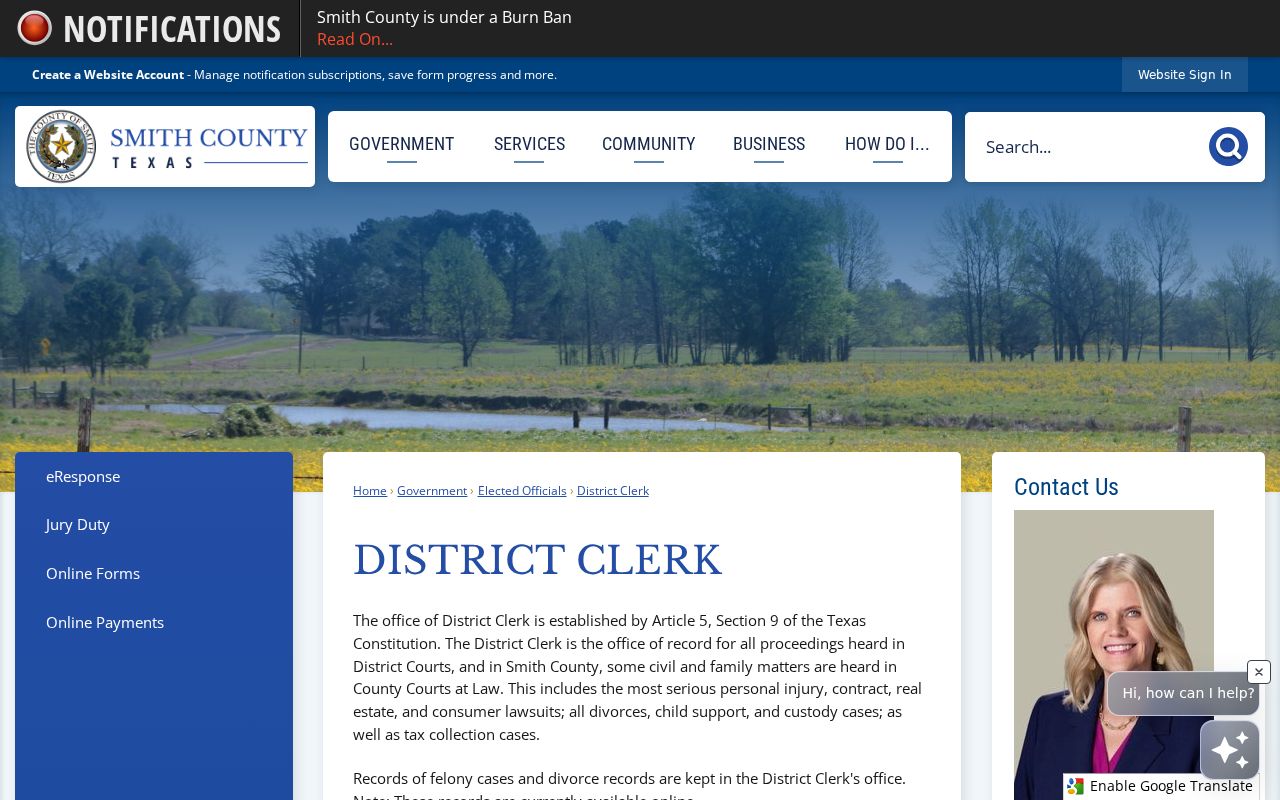
That county page ties the copy schedule to the office maintaining District Court records.
Docket, Document, and Calendar
Three products, three questions. A docket shows the sequence of case events; a document holds the text actually filed with the clerk; a calendar lists matters set for a date or category. Mix them up and your docket search may stop short of what you need.
- Docket entry
- A dated line stating that an event, filing, setting, or result was recorded.
- Filed document
- The pleading, motion, notice, order, judgment, or exhibit behind an entry.
- Setting
- A planned court event such as arraignment, hearing, trial, or status review.
- Reset
- A replacement date entered after an earlier setting changes.
- Disposition
- The recorded outcome that resolves a charge, claim, or case.
- Certified copy
- A copy formally authenticated by the clerk, not a portal printout.
Context beats a single line on the screen. Read the event before and after a setting, because a compliance or status date is not a disposition. A reset is not a dismissal. A charge is not a conviction. For the actual terms of a filed order, request the document itself rather than trusting the short docket label.
City-by-City Court Dockets in Smith County
Municipal court access in Smith County is city-specific. Tyler, Whitehouse, Lindale, and Bullard each run a local route for Class C, traffic, or ordinance matters. Hideaway offers no separate official municipal-court portal. In every city, read the citation first. The issuing agency and court named there decide where to search or pay. A municipal case may never appear in the county Odyssey index. And a nearby justice court does not gain jurisdiction just because its office is close.
Tyler Court Records
2020 population 105,995. Tyler Municipal Court is a criminal court of record and handles city Class C matters.
Whitehouse Court Records
2020 population 8,257. The city portal searches by citation, license, vehicle, or name.
Lindale Court Records
2020 population 6,059. Municipal Court and Justice Precinct 5 are separate local routes.
Bullard Court Records
2020 population 3,318. The municipal court provides a verified counter and payment route.
Hideaway Court Records
TSHA reports 3,201 residents in 2020. Use the citation and verified City Hall contact to identify the court.
One caution about the numbers. Population figures explain the top-five city selection, not court workload. Tyler's city page separately says about 45,000 cases are filed annually, and OCA publishes different reporting categories and periods. Keep those measures distinct.
Map and Directions to the Smith County Courthouse
District Court records for Smith County's five district courts (7th, 114th, 241st, 321st, and 475th) are kept by the District Clerk at the Smith County Courthouse, 100 North Broadway, Room 204, in downtown Tyler. Most district courtrooms sit in the Courthouse itself: the 7th in Room 203, the 114th in Room 212, the 241st in Room 114, and the 475th in Room 220. The 321st District Court, County Court at Law civil/probate records, and the County Clerk's office instead sit at the Courthouse Annex at 200 East Ferguson.
Smith County Courthouse (District Clerk)
100 North Broadway, Room 204
Tyler, TX 75702
903-590-1660
Monday through Friday, 8 a.m. to 5 p.m.; payments stop at 4:30 p.m.
Arraignments generally begin at 8 a.m. in the Central Jury Room unless a notice states otherwise, and bonded defendants must appear or risk forfeiture. Bring photo identification. The county has not published a single consolidated floor plan or public-terminal policy, so calling the assigned court or clerk ahead confirms the current room and security procedure.