
Tyler Court Docket Searches
Pull out the paper citation or court notice first. It tells you where the case lives. A case assigned to Tyler Municipal Court runs through the city route, not the Smith County recording index. The official municipal page gathers court FAQs, payment options, a virtual schedule, and records functions in one place, so treat it as your entry point rather than a guessed URL.
- Read the court, citation number, and response date on the notice.
- Wait 72 hours after a new Tyler citation before checking the city route.
- Open the official Tyler Municipal Court page and follow its current records link.
- Match the citation, charge, status, and Tyler court setting.
- Call or visit the Tyler clerk if the record does not appear.
- Use Smith County Odyssey only for a case filed above the city tier.
Save a copy of any docket result you pull. Still, a portal answer can change and is never automatically a certified copy, so confirm the setting with the clerk.
Tyler's 72-Hour Search Wait
The Tyler court FAQ tells drivers to wait 72 hours after a citation before searching. That gap lets the issuing agency and the clerk system finish processing the record. Search sooner and you may get a false no-hit. The wait does not extend your separate response deadline. That clock keeps running on its own.
Still nothing after the wait? Double-check the citation number and the court name. A ticket written by another agency may actually belong elsewhere. It could sit in a Smith County Justice of the Peace court. Call the court printed on the ticket before jumping into a countywide name search.
Note: The 72-hour posting wait and the response deadline are separate Tyler court rules.
Inside the Tyler Municipal Court
Tyler Municipal Court is a criminal court of record under the city charter. Its docket covers Class C misdemeanors, including traffic and city-code cases. Juvenile matters, Tyler ISD truancy cases, and certain DPS driver-license hearings also land here. Judge Amy McCullough serves as presiding judge in the official material. None of that makes the municipal clerk the keeper of district felonies or county civil files. Those live with Smith County.
You can reach the court in person at 813 North Broadway Avenue, Tyler, Texas 75702. Mail goes to PO Box 895, Tyler, Texas 75710. The main line is 903-531-1266 and the fax is 903-531-1369. The lobby opens weekdays from 7 a.m. to 4 p.m. Telephone hours run to 5 p.m.
Tyler's Municipal Court Entry
The official Tyler page makes the safest starting point for a docket lookup. City links shift over time while the court itself stays put. That page groups citation functions, court records, FAQs, and schedule information under one named agency. That beats a remembered payment URL or an unverified commercial site every time. View the official Tyler Municipal Court source. The page shows the court's scope. It also keeps the municipal search distinct from the Smith County Odyssey system.
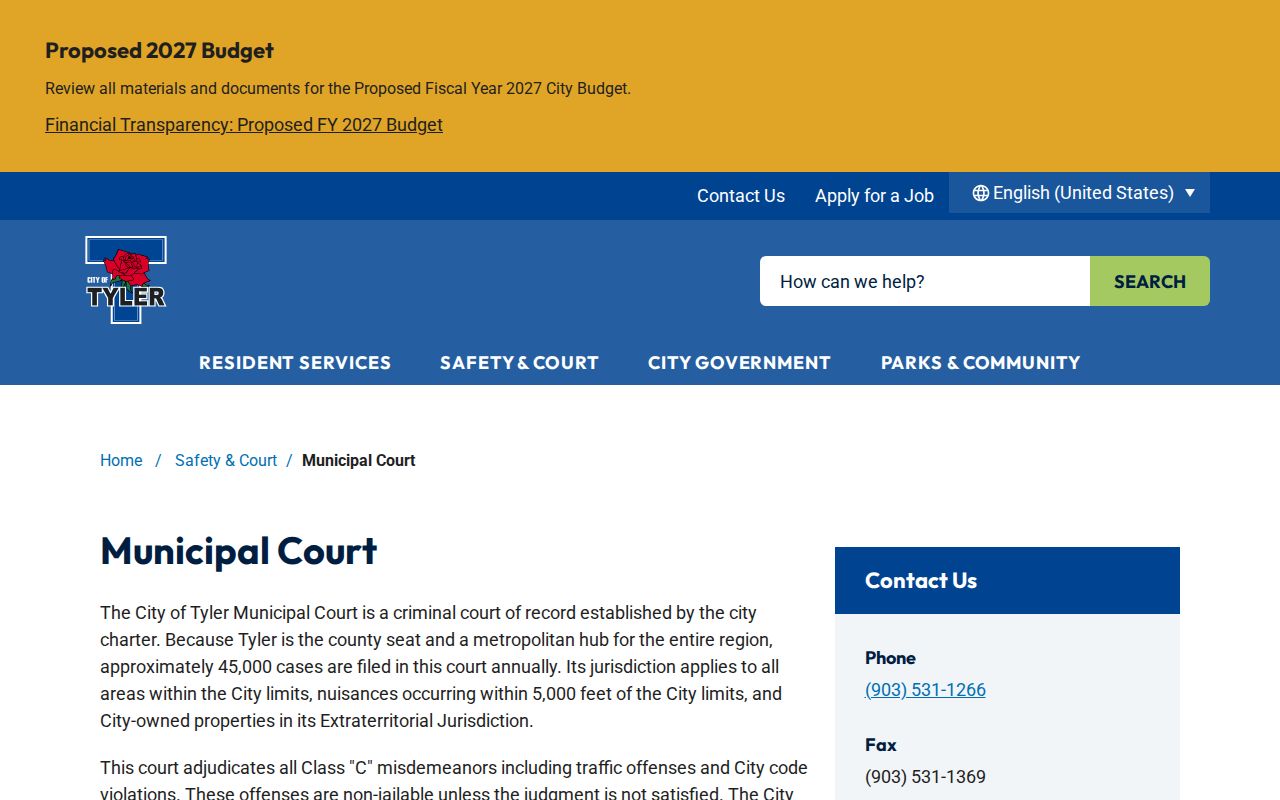
The Tyler municipal entry stands apart from Smith County Odyssey. City cases stay in the city system, county cases in the county's.
Finding Tyler Court Dates
A Tyler setting on the docket can be an appearance, a pretrial event, a trial, or a compliance step. Read the date together with its event label. The date printed on a citation is usually a response deadline. It is not usually a trial date. A newer notice or a valid court reset can replace an earlier date. So ask the municipal clerk whenever an entry looks unclear.
| Citation Number | The city identifier used to locate the Tyler record. |
|---|---|
| Date | The response or hearing date shown by the Tyler court. |
| Time | The stated time for the event, if separately assigned. |
| Setting Type | Appearance, pretrial, trial, compliance, or another step. |
| Status | The current procedural label, not proof of a final outcome. |
| Court Location | The municipal court venue named on the notice. |
A phone call can clear up what the docket entry means. Tyler is firm on one point, though: a call does not count as an appearance. You still must complete whatever formal response the court requires.
The 20-Day Tyler Citation Clock
Tyler's published FAQ sets a hard limit. Appear no later than 20 calendar days after the citation. Anyone under 17 must appear. Don't borrow Tyler's timing for a case in Whitehouse, Lindale, Bullard, or a JP court. Those courts may publish different rules. The city's FAQ gathers the wait, the deadline, plea routes, and local options in one place. Review Tyler's current appearance and disposition rules. Terms can change, so check the FAQ before relying on an older printout.
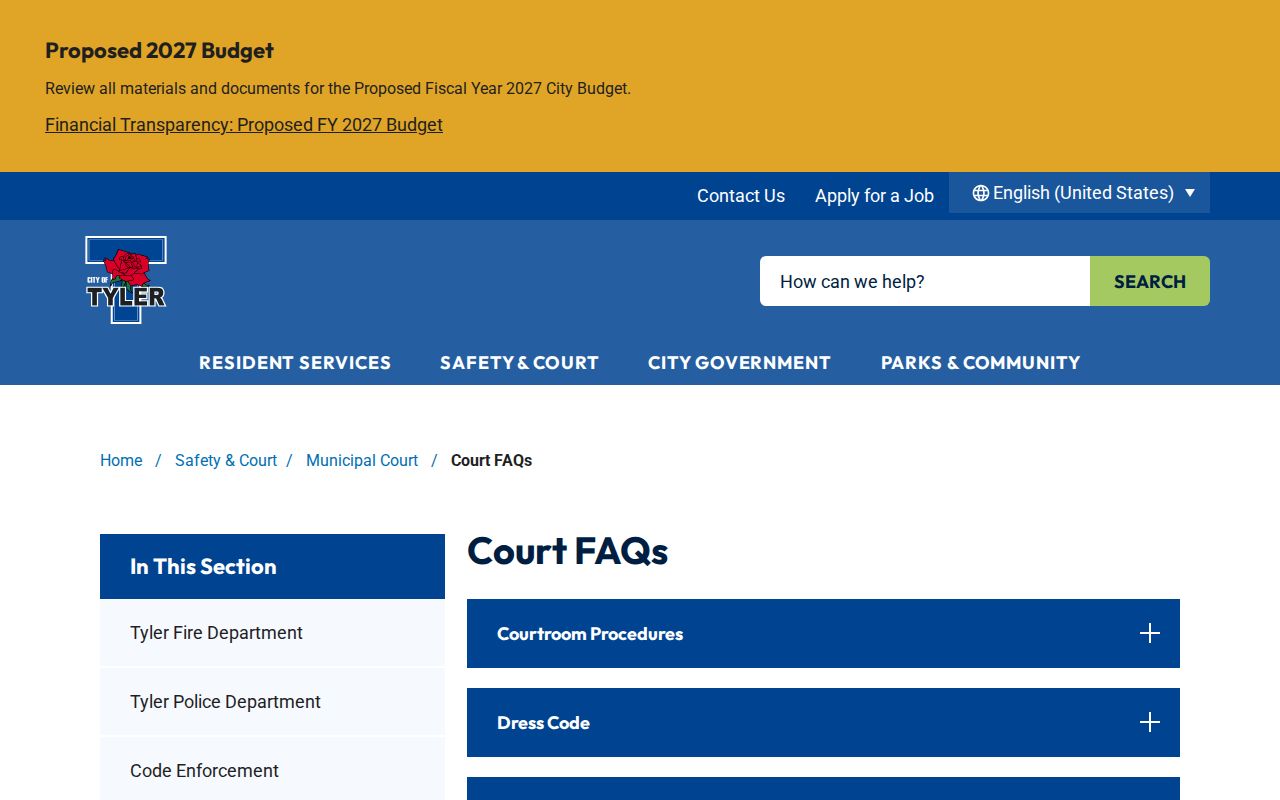
Verify the current FAQ terms. An old printout may no longer match the court's rules.
Tyler Traffic Ticket Lookups
A Tyler Police citation naming Tyler Municipal Court should start with the city court. Use the citation number too. The record may list the alleged Class C offense, the plea, a court date, payment, or the disposition. That file is not the same as a Texas driving history. The wider city-versus-JP routing question has its own answer. The Smith County traffic court record page explains which clerk holds which record.
A guilty or no-contest route triggers fine and cost treatment under Tyler's current procedure. Plead not guilty and the case moves to the trial docket. A jury hears it unless waived. Those are real court choices, not search filters. Read the court's current instructions before you click or pay.
Do not rely on a phone call as appearance. Tyler instructs a cited person to complete the required formal response within the city deadline.
Tyler Trial Docket Choices
A not-guilty plea sends the case down a trial path. Tyler's FAQ describes a jury trial unless the right is waived. From there the docket reflects the court's procedural settings leading up to trial. Paying, or entering a guilty or no-contest plea, follows a different route. It may create a disposition on the record. Check what the portal shows before you submit any online selection.
| Tyler response | Record effect | What to verify |
|---|---|---|
| Not guilty | Moves toward a trial docket | Pretrial or trial notice and jury choice |
| Guilty or no contest | Moves toward fine and costs | Final amount and disposition terms |
| Deferred disposition | Conditional court process | Eligibility, term, and proof |
| Driving safety course | Possible dismissal route | Request deadline and limits |
Tyler also publishes dismissal procedures for proof of insurance and for driver-license or registration defects. Each carries its own timing, proof, and fee terms. Never assume eligibility from a portal label alone.
Tyler Safe Harbor Questions
Tyler's own FAQ points people with warrant questions to the phone, and it sketches a safe-harbor practice: come in voluntarily on a Tyler warrant and the court will work with you. That courtesy is a Tyler policy. Do not assume a JP court or another city court follows it.
A Tyler docket may show a missed setting or a warrant status. Act fast. Call the court, name the citation, and ask what formal step clears it. Staff can explain procedure but not give legal advice. A lookup alone never clears a warrant or counts as an appearance.
Note: Tyler's current warrant instructions govern, since a city-specific practice can change.
How Tyler Cases Reach County
Tyler Municipal Court stays inside its narrow city jurisdiction. Class A and B misdemeanors can move up to Smith County Courts at Law and the County Clerk. Felonies and major district matters land in Smith County District Courts with the District Clerk. Where civil, family, and probate cases go depends on the court that law and the filing assign.
Docket flow: Tyler Municipal Court › Smith County Courts › Smith County District Court
Once you confirm a case is not municipal, use Smith County Odyssey for the county judicial layer. Smart Search and Search Hearings are two different tools there. The County Clerk's Official Public Records portal is only a recording and land index. It is not the next stop for a Tyler citation.
Tyler's Three Courthouse Systems
Downtown Tyler holds several record counters with street addresses that sound alike. Tyler Municipal Court sits on North Broadway. The Smith County District Clerk and County Clerk work out of county buildings on Broadway and Ferguson. The federal Eastern District of Texas Tyler Division sits at 211 West Ferguson Street. None of these systems share one docket.
A city citation stays with Tyler Municipal Court. A Smith County felony or divorce file belongs to the District Clerk, and a federal case runs through PACER and the federal clerk. So pair every address with the full court or clerk name before you drive downtown, or you may stand at the wrong counter.
- Municipal record
- A Tyler city case within Municipal Court jurisdiction.
- County docket
- A Smith County case in a county or district trial court.
- Federal docket
- An Eastern District case searched through the federal system.
Tyler Court Record Access
Ask the city court clerk for public Tyler municipal records. Texas law, court orders, redaction, and confidentiality all shape what gets released. A public index can leave out juvenile or other protected material. No hit is not proof a record never existed. Request the specific public docket entry, order, or certified disposition you need.
Access framework:
Texas Judicial Branch policy explains why court access is not governed like ordinary executive records.
Texas Rule 12 governs judicial administrative records, not a shortcut around filed-case procedures.
Texas Government Code Chapter 552 applies to covered governmental information under its own terms.
Want a certified Tyler municipal record? Give the clerk the citation or cause number, the exact item, and your preferred delivery. The city clerk sets the current fee and method.
Tyler's Municipal Docket Scale
Tyler's official court page puts filings near 45,000 cases a year. The OCA 2024 municipal report frames things differently. It lists 30,002 added, 29,673 disposed, and 50,009 ending active for Tyler. Its population field reads 110,327 for that report vintage. The 2020 Census figure for the same city is 105,995.
These are workload totals. They say nothing about any one person's outcome. The city statement and the OCA table also use different definitions and periods, so do not treat them as conflicting or combine them.