
Smith County Criminal Docket Searches
The county's Odyssey public portal is the fastest route into a Smith County docket search. Pick Smart Search for court records. Search Hearings covers a date range of settings, and Jail Search tracks custody rather than any court outcome. An exact cause number works best. A party name works when the number is unknown. But check every match against the court, the case type, the filing date, and the party's role before trusting it.
The portal builds its forms with JavaScript. Fields depend on how the screen loads. Tyler's general guidance says the basic box takes a full case number or a party name. It does not support wildcards. Advanced Search may add filters for person, location, and case type. Trust the screen in front of you over any fixed set of instructions.
- Classify the charge as felony, Class A or B misdemeanor, or Class C.
- Open Odyssey Smart Search and use the exact cause number when known.
- Match the result to the court, offense level, dates, and party role.
- Read events and verify the next setting with the assigned court.
- Ask the proper clerk for a plain or certified copy when needed.
Felony or Misdemeanor Clerk?
Two clerks split the criminal docket in Smith County. The District Clerk holds felony records from the district courts. The County Clerk keeps Class A and B misdemeanor records for the Courts at Law. Ask the wrong office. You may walk away thinking the case does not exist. The County Clerk FAQ sends felony inquiries straight to the District Clerk.
| Case level | Typical court | Record route |
|---|---|---|
| Felony | District Court | District Clerk and Odyssey |
| Class A or B misdemeanor | County Court at Law | County Clerk and Odyssey |
| Class C, fine only | Justice or municipal court | Citation's named court |
A city ticket can fall outside the county portal entirely. Look at the agency and the court printed on the citation, because Tyler, Whitehouse, Lindale, Bullard, and Hideaway each run their own municipal system rather than one shared docket.
Criminal Dockets: What They Show
Think of a criminal docket as an event index, not the whole case file. Its lines let you trace how a charge moved through the court, hearing by hearing. Labels differ from court to court, and no image is public for every entry. A match on a similar name proves nothing, either. Confirm you have the right party before drawing conclusions.
| Case number | The court's cause number for one proceeding. |
|---|---|
| Charge and level | The alleged offense and classification, not proof of guilt. |
| Status | Open, pending, disposed, or another court-defined state. |
| Setting | Arraignment, pretrial, plea, trial, or compliance event. |
| Disposition | The recorded outcome, such as dismissal, plea, or judgment. |
| Documents | Filed-item descriptions or links where access permits. |
Anchor each lookup in the cause number, the court, and the event date together. Smith County case numbers follow no single safe format, so a made-up example here would mislead more than help.
Smith County Appearance Calendar
The county's District Court Felony Appearance Calendar groups people by arrest date. It routes each group to its assigned district court under Senate Bill 7. It covers appearance dates. It also handles capias and transport for defendants held in custody. Treat it as a routing schedule rather than a full criminal docket.
Read the arrest-date schedule next to the individual docket and the assigned court. A grouping can narrow your search. But only the live setting and the case's event history tell you where the case stands today.
Criminal Case Stages on the Docket
A felony docket often opens with a charge or indictment. Then it runs through arraignment and pretrial events. Next come a plea or trial, disposition, and sentencing. Misdemeanor cases follow a similar path in the assigned Court at Law. Each line marks an action or a setting. Keep in mind that a scheduled event did not necessarily happen on the date first listed.
Docket flow: Filing › Arraignment › Pretrial › Plea or Trial › Disposition › Sentencing
- Arraignment
- A setting where the charge and plea are addressed.
- Capias
- An order directing that a person be taken into custody.
- Reset
- A later date assigned in place of an earlier setting.
- Disposition
- The recorded result that resolves a charge or case.
Judge a case by the whole sequence, never one line. A filed charge is an allegation, not a conviction. A jail entry, likewise, is not a disposition.
Smith County Arraignment Details
Court at Law 2 sets arraignments at 8 a.m. in the Central Jury Room unless your notice says otherwise. The court's page also explains waiver timing and tells readers to verify settings in Judicial Records Search.
That official page supplies the local details, so read it before you plan the morning of an arraignment.
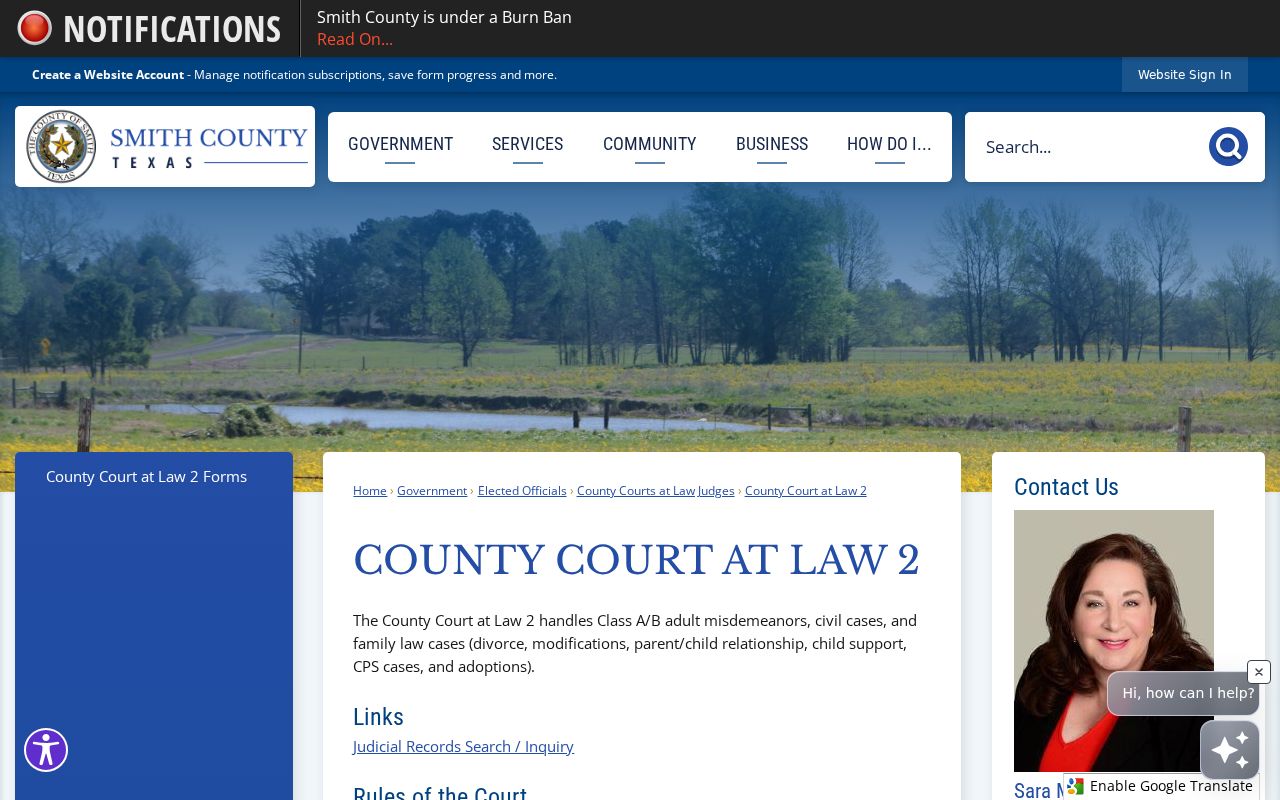
A court's own page often carries arrival rules or waiver details that a case row online will not show.
Court at Law 3 posts criminal, arraignment, and compliance or status lists plus a Thursday morning jail call. Those labels are calendar items, not outcomes.
The court's official page lays out these court-specific options.
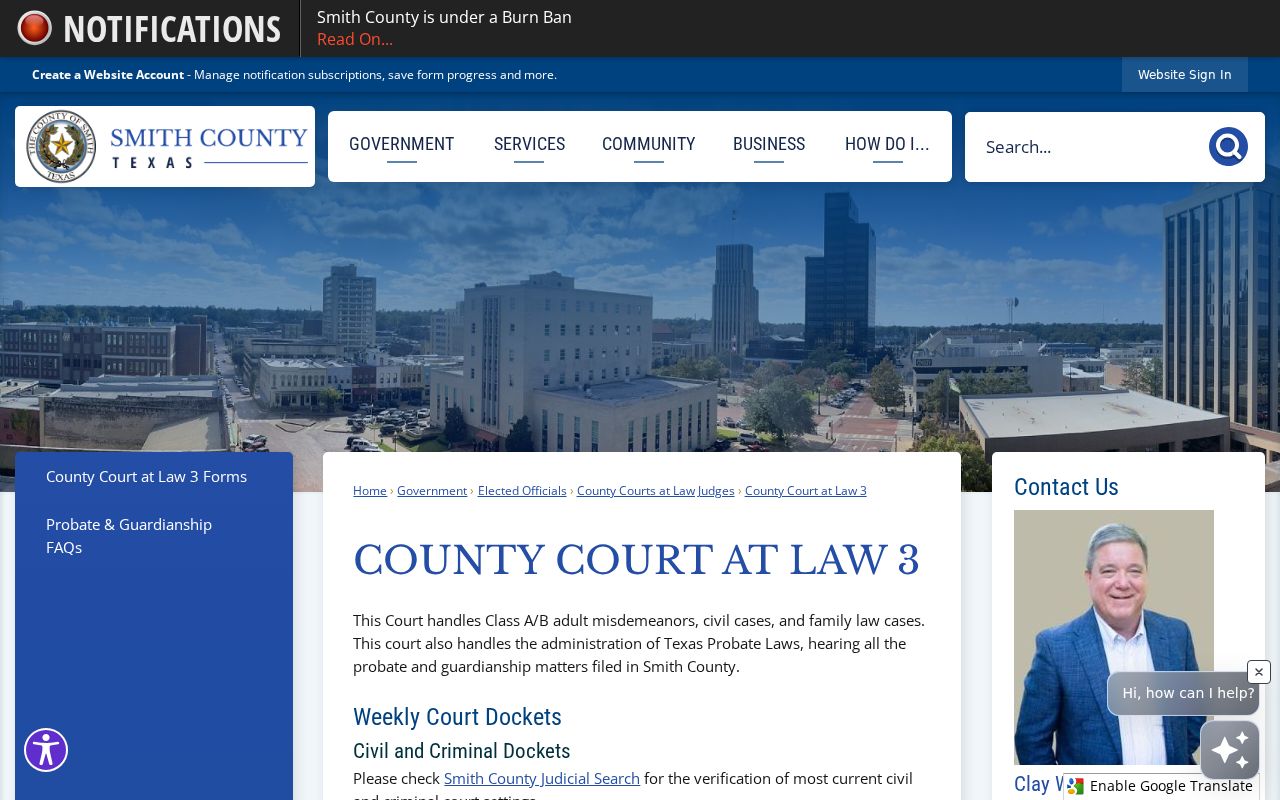
The capture reinforces that each Court at Law can publish distinct docket instructions.
Smith County Criminal Docket Courts
Five District Courts serve Smith County: the 7th, 114th, 241st, 321st, and 475th. Each has its own room and assignments. The three Courts at Law handle Class A and B misdemeanors. Justice and municipal courts take fine-only Class C matters under their own precinct or city authority. Court at Law 1 explains its jurisdiction. Its official page also shows how to reach the court.
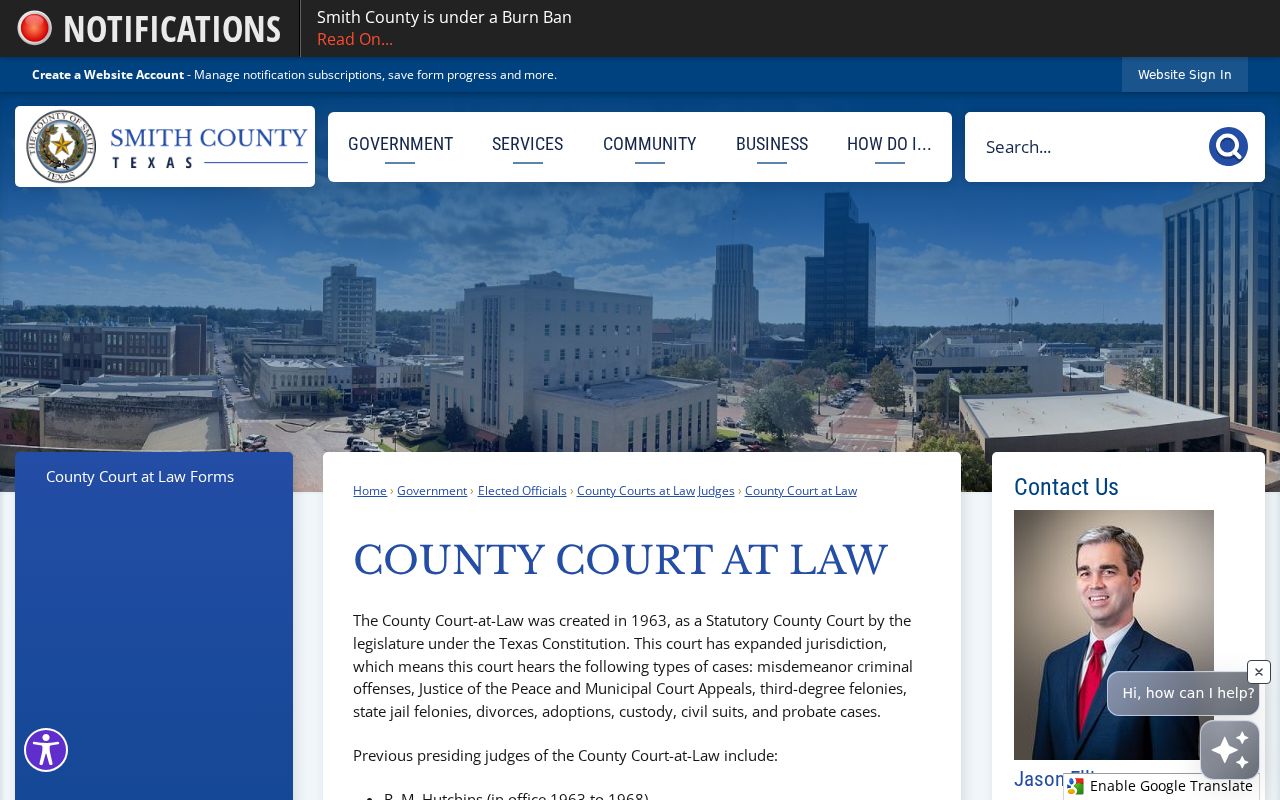
A court's jurisdiction and a clerk-held docket are connected. But they are not the same thing.
An appeal from justice or municipal court can land in a Court at Law. State trial-court appeals from Smith County go to the Twelfth Court of Appeals in Tyler. Federal criminal matters belong to the Eastern District of Texas and PACER, not Odyssey.
The 1976 Misdemeanor Backstop
The County Clerk's misdemeanor division reports that Smith County records reach back to 1976. When an older Class A or B misdemeanor fails to appear online, hand the clerk a name, the likely court, an approximate date, and any cause number you have. Copy requests can go to crimcopies@smithcounty.com or 903-590-4680.
The posted schedule charges a $5 case search plus $1 per printed page. Confirm the fee and the product before you pay. A paid search is not a certified copy. The clerk can often also report the court, a court date, an attorney, or a bondsman when that information is on file.
No online hit? Check offense level, spelling, venue, and date range. A sealed case, delayed index, municipal matter, or outage can also explain an empty result.
Odyssey Outage Lesson
Smith County learned a useful lesson on October 21, 2024. That day the county posted notice about public judicial search. It was working again after a multi-week outage. The fix tells you something important about dockets. A portal being down does not mean the court record is gone. Availability and existence are two different questions. When the system goes dark, felony records still exist at the District Clerk. That office is reachable at 903-590-1660. For misdemeanors, call the County Clerk line at 903-590-4680.
Prefer talking to a person anyway? The District Clerk counter sits at 100 N Broadway, Room 204, in Tyler. Misdemeanor court records live on the third floor of the Annex at 200 E Ferguson. Before you drive over, ask whether a terminal or a calendar printout is on hand. Bring the cause number too. Then request what you actually need. That could be a docket sheet, a filed document, a plain copy, or a certified copy.
Access Rules for Criminal Dockets
Plenty of a criminal docket is open to anyone, yet not all of it is. Sealed matters stay closed. Juvenile information stays protected. Some filings arrive redacted or withheld entirely. There is a reason the rules differ from what you might expect. The Texas Judicial Branch policy lays out why ordinary court records do not fall under the Texas Public Information Act the way executive branch records do.
Key rules:
Texas Rule of Judicial Administration 12 governs judicial records about court administration, with exemptions and appeals.
Texas Government Code Chapter 552 is the public-information baseline, not a universal case-file route.
Smith County's public-information page routes judicial and clerk-held records to the proper channels.
Name the product you want, exactly. If staff say no, ask which rule or order controls the denial, since a court docket decision usually traces to written authority. Staff can walk you through process, but they cannot give legal advice.